In today’s rapidly changing workplace, the pace of skill evolution is faster than ever. According to LinkedIn Learning (2024), the skills required for most jobs change by nearly 25% every five years. For HR and Learning & Development (L&D) teams, this means traditional, one-size-fits-all training is no longer enough. Organizations now need learning that is measurable, strategic, and adaptable — learning that transforms behavior and performance.
That’s exactly what Instructional Design (ID) delivers. Instructional Design isn’t just about creating courses; it’s about building learning experiences that drive results, align with business goals, and prepare employees for the future of work.
Instructional Design is the systematic process of analyzing learning needs, designing effective training solutions, and evaluating learning outcomes. It blends education, psychology, and technology to ensure that learning is not just engaging but impactful.
Some of the most widely used instructional design models include:
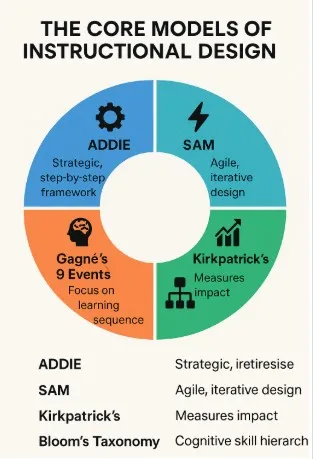
These frameworks ensure that training is grounded in proven learning theory rather than guesswork — a key reason why ID has become central to HR and L&D transformation.
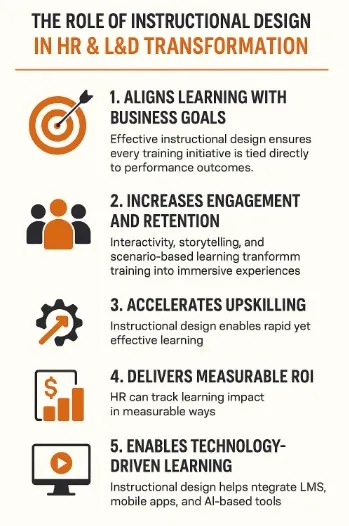
Instructional Design is reshaping how HR and L&D teams deliver value. Here’s how:
Effective instructional design ensures every training initiative is tied directly to performance outcomes, whether it’s improving sales efficiency, boosting leadership skills, or enhancing compliance.
By using interactivity, storytelling, and scenario-based learning, instructional design transforms training into immersive experiences. Microlearning and gamified modules can increase knowledge retention by up to 80% compared to traditional lectures.
In a fast-moving business landscape, organizations must help employees learn new tools and skills quickly. Instructional design enables rapid yet effective learning through modular, mobile-friendly, and personalized content.
Through data-driven evaluation methods like Kirkpatrick’s model, HR can track learning impact in measurable ways — from productivity improvements to behavioral change.
Instructional design helps organizations integrate learning management systems (LMS), mobile apps, and AI-based tools seamlessly, ensuring scalable, accessible learning for diverse workforces.
Recent studies highlight just how critical instructional design has become for modern learning ecosystems:
| Category | Key Insights | Supporting Data / Source |
| Project Load | Full-time instructional designers complete about 12 projects per year on average. | Synthesia – State of Instructional Design Survey (2024) |
| Work Distribution | 66% of work involves creating new courses; 34% focuses on updating existing ones. | Synthesia Survey (2024) |
| Project Timelines | 29% of projects take 21–50 days; 23% extend beyond 50 days. | Synthesia Survey (2024) |
| Time Allocation | Development & Implementation: 37–39%Design: 22–23%Analysis: 17–18% | Synthesia Survey (2024) |
| Business Impact | Structured instructional design boosts learner engagement by 45% and reduces onboarding time by 35%. | LinkedIn Learning Report (2023) |
| Technology Integration | 70% of L&D teams now use AI, LMS, or microlearning platforms. | LinkedIn Learning Report (2024) |
| Industry Growth | The global Instructional Design & eLearning market projected to reach USD 375 billion by 2028 (14% CAGR). | Fortune Business Insights (2024) |
These figures show that instructional design is no longer an optional HR function — it’s a strategic business necessity.
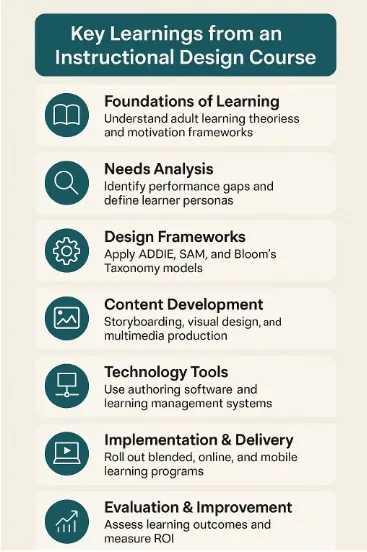
An Instructional Design course is designed to help professionals master the science and art of creating effective learning programs. Whether you’re an HR manager, L&D professional, educator, or aspiring designer, this course builds essential capabilities for the future of learning.
Here’s what you typically learn:
Instructional Design is one of the most in-demand skills in today’s learning economy. According to the U.S. Bureau of Labor Statistics, jobs in training and development are expected to grow by 8% by 2032, faster than the average across occupations.
Professionals can pursue roles such as:
In India, instructional design professionals earn between ₹6–10 LPA at entry level, while senior roles at multinational corporations or EdTech companies can exceed ₹20 LPA. The rise of hybrid work, digital learning platforms, and corporate upskilling programs continues to expand opportunities in this field globally.
When HR and L&D professionals understand instructional design principles, the benefits ripple across the organization:
By integrating instructional design into their strategy, HR teams move from managing training events to building learning ecosystems that genuinely drive business transformation.
Instructional Design is no longer just a technical skill it’s a strategic capability. As businesses undergo digital transformation, the ability to design effective, data-driven learning programs will define the success of HR and L&D teams worldwide.
At Chaperone Learning Solutions, we believe that Instructional Design is the bridge between knowledge and performance. Our mission is to empower educators, trainers, and HR professionals with the tools to create impactful learning experiences that inspire, engage, and deliver real results.
In a world where learning never stops, Instructional Design is your key to shaping the future.
Follow Us On:
WhatsApp group Link: https://chat.whatsapp.com/F1MTfuuDIKC9zQ2Adti5UX
FB: https://www.facebook.com/people/Chaperone-Academy/61566126646336/?mibextid=ZbWKwL
Insta: https://www.instagram.com/chaperoneacademy/?igsh=MXJ5emM5aHA1aHl5dA%3D%
Linkedin: https://www.linkedin.com/company/chaperonelearningsolutions