To become an instructional designer in India, learn how adults learn, master one or two eLearning authoring tools, build three or four portfolio projects, and apply to corporate L&D teams, EdTech companies or freelance clients. A teaching or IT degree helps but is not required. With a structured instructional design course and steady practice, most beginners can become job-ready in roughly four to six months. This roadmap shows you exactly how, step by step.
Key Takeaways
- Instructional designers plan and build learning experiences: eLearning modules, training videos, assessments and workshops.
- You do not need a teaching or IT background. Graduates, trainers, teachers, writers and HR professionals all switch into this field.
- Employers shortlist on portfolios first and certificates second.
- Learn ADDIE, storyboarding, Articulate 360 and LMS/SCORM basics, then add AI-assisted design.
- Indeed India listed an average base salary of about ₹7.19 lakh a year in January 2026; entry-level pay is usually lower.
What does an instructional designer do?
An instructional designer turns expert knowledge into learning that people complete and actually use. The work starts with a needs analysis, moves to measurable learning objectives and storyboards, then to building modules in tools like Articulate Storyline or Rise 360, and ends with measuring results.
In India, this work sits inside corporate L&D teams, IT services firms, EdTech companies, universities and eLearning vendors. Common job titles include instructional designer, eLearning developer, learning experience designer (LXD) and curriculum designer.
Is instructional design a good career in India?
Yes, if you enjoy mixing writing, psychology and technology. Banks, IT companies, pharma firms and manufacturers keep moving employee training online, and EdTech companies keep hiring content designers.
Pay depends on skills and portfolio quality. Indeed’s India salary page reported an average base salary of ₹7,19,289 per year in January 2026, though it rests on a small number of reported salaries. Career sites commonly quote ₹4–7 lakh for entry-level roles, rising as you specialise in LXD, AI-led course design or project management. Check Indeed, LinkedIn and Glassdoor for current numbers in your city.
How do you become an instructional designer? A 7-step roadmap
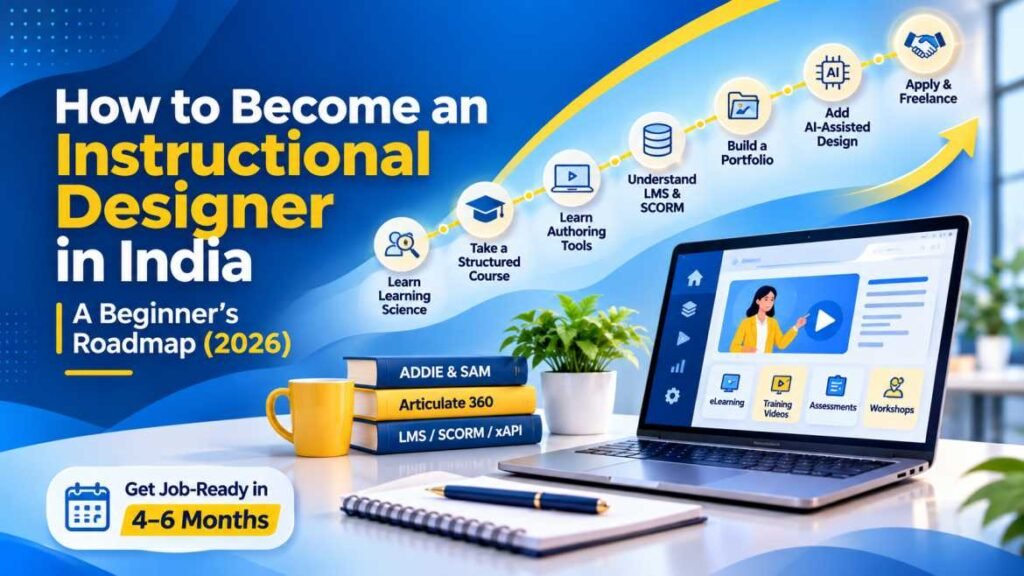
- Learn the learning science. Start with adult learning principles, Bloom’s taxonomy, ADDIE (Analysis, Design, Development, Implementation, Evaluation) and SAM, a faster, iterative alternative.
- Take a structured course. A good instructional design certification course for beginners gives you feedback, projects and mentoring that self-study rarely provides.
- Learn authoring tools. Articulate Storyline and Rise 360 are the most requested. eLearning authoring tools training should be hands-on, not just demos.
- Understand LMS, SCORM and xAPI. SCORM is the packaging standard that lets a course report completion and scores to a learning management system (LMS). Know how to publish and test a course.
- Build three to four portfolio projects. Use different formats: a microlearning module, a scenario-based course and a software walkthrough.
- Add AI-assisted design. Use AI for first drafts, quiz ideas and scenarios, then check accuracy yourself. See how AI-powered courseware design fits into a modern workflow.
- Apply and freelance. Target L&D teams and eLearning vendors, and take small freelance projects to gain real client experience.
Which skills and tools should beginners learn?
| Skill | What it means | Beginner tool or example |
|---|---|---|
| Needs analysis | Finding the real skill gap | Stakeholder interview questions |
| Learning objectives | Measurable outcomes | Bloom’s taxonomy verbs |
| Storyboarding | Planning screens, script and interactions | PowerPoint or Word storyboard |
| eLearning authoring | Building interactive modules | Articulate Storyline, Rise 360 |
| Assessment design | Checking real understanding | Scenario-based questions |
| LMS and SCORM | Publishing and tracking | Moodle, SCORM Cloud |
| Media basics | Visuals, audio, short video | Canva, Camtasia |
| AI literacy | Drafting and reviewing faster | Generative AI assistants with human review |
How do you choose the right instructional design course?
Whether you are comparing a learning and development course or an eLearning course online in India, check these points:
- The curriculum covers analysis through evaluation, not only tool clicks.
- You build real projects that go into a portfolio.
- Mentors have industry experience in L&D or eLearning.
- The format mixes self-paced lessons with live sessions and feedback.
- Certification is included, and career guidance is honest (no guaranteed-job promises).
- Syllabus, duration and fees are clearly stated.
Chaperone Academy’s learning and development course pathway is built around this approach: self-paced learning, live virtual sessions, hands-on projects and one-on-one mentoring. [ADD REAL LEARNER STORY OR MENTOR INSIGHT HERE]
The Portfolio-First Starter Framework
Most beginners collect certificates and stall. Try this five-step loop instead:
- Pick one audience, such as new bank employees or retail trainers.
- Write a one-page needs analysis stating the problem and the desired behaviour change.
- Storyboard before you build, so design decisions come before design software.
- Build a five-minute module with one scenario and one assessment.
- Add a short case note: problem, approach, tool used and result.
Repeat in a new format each time. Hiring managers read your thinking, not just your slides.
Common beginner mistakes
- Learning tools before learning design principles.
- Turning slide decks into screens (content dumping) with no interaction or purpose.
- Skipping assessment and measurement.
- Showing portfolio samples without explaining the problem and your decisions.
- Trusting AI output without checking facts, tone and learning value.
Frequently Asked Questions
Can I become an instructional designer without a teaching or IT background? Yes. Many instructional designers come from writing, HR, training, teaching or operations. What matters is understanding how people learn, using authoring tools and showing your work in a portfolio.
How long does it take to become an instructional designer in India? Most beginners need about four to six months of structured learning and project work. Learners with training or content experience may move faster, while part-time learners may take longer.
What does an instructional designer earn in India? Entry-level roles are commonly quoted at ₹4–7 lakh a year, while Indeed showed an average base of about ₹7.19 lakh in January 2026 [VERIFY]. Pay varies by city, employer, tools and portfolio strength.
Is an instructional design certification necessary? Not legally, but it helps. A certification gives structure and credibility, especially for career switchers. Employers still weigh your portfolio and design thinking most.
Conclusion
Becoming an instructional designer is a practical, learnable path: study the learning science, master the tools, build a portfolio and keep refining with feedback. If you want guidance choosing the right route, book a free consultation with Chaperone Academy and map a plan to your goal, whether that is getting hired, switching careers or freelancing.